
1. Introduction
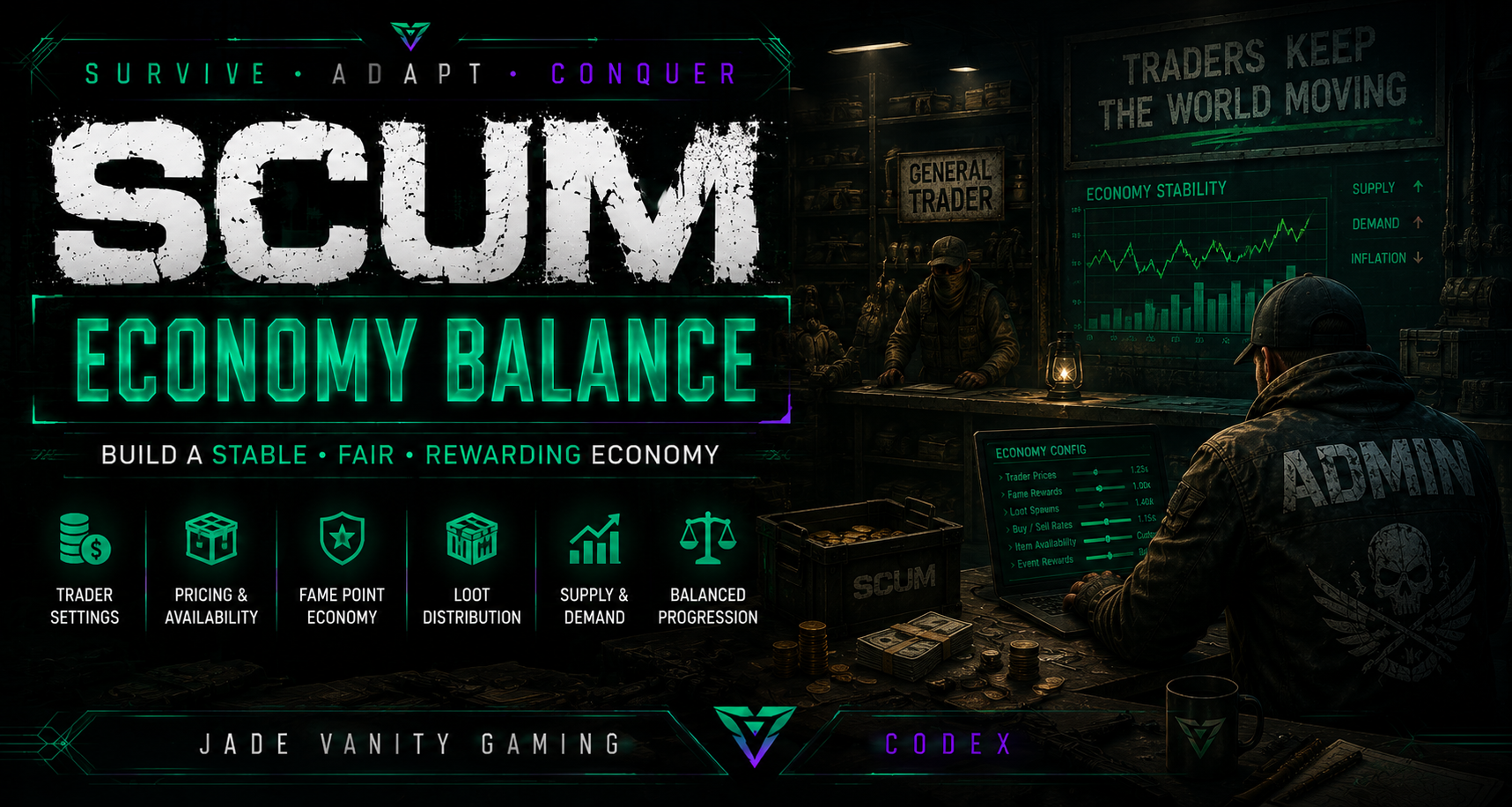
Creating a balanced economy in SCUM is crucial for maintaining player engagement and ensuring a rewarding gameplay experience. This guide will help you understand the various economic systems in SCUM and provide practical advice for balancing them on your server.
A well-balanced economy creates meaningful progression, encourages player interaction, and prevents both excessive grinding and too-rapid advancement. Whether you're running a PvP-focused server or a more cooperative PvE environment, these principles will help you create an economy that enhances your server's unique gameplay style.
Note: This guide assumes you have basic knowledge of SCUM server administration. If you're new to running a SCUM server, check our SCUM Server Setup Guide first.
2. SCUM Economy Overview
The SCUM economy consists of several interconnected systems:
- Traders - NPCs who buy and sell items for fame points
- Fame Points - The primary currency earned through various activities
- Loot - Items found in the world through exploration
- Events - Special activities that provide rewards
- Quests - Structured tasks with defined rewards
These systems interact to create the overall economic experience. For example, if loot is too abundant, trader prices become less relevant. If fame points are too easy to acquire, high-end items at traders become too accessible.
Economic Goals
Before making changes to your server's economy, consider what you want to achieve:
- Progression Speed - How quickly should players advance from basic to high-tier gear?
- Player Interaction - Do you want to encourage trading between players?
- Risk vs. Reward - How should dangerous activities be rewarded?
- Specialization - Should players be able to excel in all areas or specialize?
- Server Longevity - How long should it take to "complete" the progression?
Your answers to these questions will guide your economic decisions throughout this guide.
3. Trader Configuration
Traders are central to the SCUM economy, providing both a source of items and a sink for fame points. Properly configuring traders is essential for a balanced economy.
3.1 Trader Configuration Files
Trader settings are stored in JSON files located in the server's configuration directory:
SCUM\Saved\Config\WindowsServer\TradersThe main files you'll need to modify are:
TraderConfig.json- General trader settingsTraderInventory.json- Items available at each traderTraderPrices.json- Buy and sell prices for items
To export the current trader configuration, use the admin command:
#ExportTradersThis will create the necessary files if they don't exist, or update them with the current settings.
3.2 Price Adjustments
Adjusting item prices is one of the most direct ways to balance your economy. Here are some principles to consider:
Price Tiers
Create clear price tiers that reflect item value and rarity:
| Tier | Item Examples | Suggested Price Range |
|---|---|---|
| Basic Survival | Basic food, water, simple tools | 10-50 fame |
| Common Equipment | Basic weapons, common ammunition, basic clothing | 50-200 fame |
| Advanced Equipment | Military clothing, mid-tier weapons, medical supplies | 200-500 fame |
| High-End | High-tier weapons, rare ammunition, specialized equipment | 500-2000 fame |
| Premium | Best weapons, vehicles, rare items | 2000+ fame |
Buy/Sell Ratio
The difference between buy and sell prices creates an economic "friction" that prevents players from exploiting the system. A good rule of thumb:
- Traders should buy items for 20-40% of their sell price
- Higher tier items should have a larger buy/sell gap
- Essential survival items can have a smaller gap to help new players
Example price adjustment in TraderPrices.json:
{
  "ItemPrices": [
    {
      "ItemId": "BP_Weapon_AK47",
      "BuyPrice": 1200,
      "SellPrice": 400
    },
    {
      "ItemId": "BP_Ammo_762x39",
      "BuyPrice": 10,
      "SellPrice": 3
    }
  ]
}
3.3 Item Availability
Controlling which items are available at traders is as important as setting prices. Consider these strategies:
Trader Specialization
Each trader type should have a specialty that makes visiting different traders worthwhile:
- Armorer - Weapons, ammunition, and armor
- General Goods - Basic supplies, tools, and common items
- Fisherman/Harbourmaster - Fishing equipment, boats, and water-related items
- Doctor - Medical supplies and health-related items
- Mechanic - Vehicles, vehicle parts, and tools
Stock Limitations
Limiting the quantity of high-tier items available at traders creates scarcity and value:
- Set lower stock limits for powerful weapons and rare items
- Consider longer restock times for premium items
- Basic survival items should have higher stock to prevent frustration
Example configuration in TraderInventory.json:
{
  "TraderInventories": [
    {
      "TraderType": "Armorer",
      "Items": [
        {
          "ItemId": "BP_Weapon_AK47",
          "Amount": 2,
          "RestockAmount": 1,
          "RestockInterval": 7200,
          "FameRequired": 1000
        },
        {
          "ItemId": "BP_Ammo_762x39",
          "Amount": 200,
          "RestockAmount": 50,
          "RestockInterval": 3600,
          "FameRequired": 0
        }
      ]
    }
  ]
}
In this example:
- The AK-47 is limited to 2 in stock, restocks 1 every 2 hours (7200 seconds), and requires 1000 fame to purchase
- The ammunition is more plentiful with 200 in stock, restocks 50 every hour, and has no fame requirement
4. Fame Point Economy
Fame points are the primary currency in SCUM, earned through various activities and spent at traders or for other benefits. Balancing fame acquisition and expenditure is crucial for a healthy economy.
4.1 Fame Acquisition Rates
Players can earn fame through various activities. You can adjust these rates in your server settings:
| Activity | Default Fame | Balanced Suggestion |
|---|---|---|
| Killing zombies | 5-10 | 3-8 |
| Killing animals | 5-20 | 5-15 |
| Killing players | 25-100 | 20-50 |
| Completing events | 50-200 | 75-250 |
| Completing quests | Varies | Tier 1: 50-100 Tier 2: 100-200 Tier 3: 200-400 |
To adjust the fame multiplier, modify the Game.ini file:
[/Script/SCUM.SCUMGameSession]
bIsFameEnabled=True
bIsFamePointsMultiplierEnabled=True
FamePointsMultiplier=1.0
Setting FamePointsMultiplier to values below 1.0 will make fame harder to earn, while values above 1.0 will make it easier.
Tip: Monitor how quickly players are accumulating fame. If players are reaching end-game gear too quickly, consider reducing the multiplier. If progression feels too slow, increase it slightly.
4.2 Fame Point Sinks
Creating effective "fame sinks" (ways for players to spend fame) is essential for long-term economic health. Consider these options:
Consumable Items
Ensure that consumable items like ammunition, medical supplies, and food are priced to create a steady drain on fame points.
Maintenance Costs
Items that require maintenance (like vehicles or high-tier weapons) create ongoing fame costs.
Fast Travel
If enabled, fast travel costs can be an effective fame sink. Consider scaling costs based on distance.
Respawn Options
Premium respawn options (like respawning with basic gear or at specific locations) can cost fame points.
Base Building
Make advanced base building components cost fame at traders to create a significant late-game fame sink.
To configure fast travel and respawn costs, modify the Game.ini file:
[/Script/SCUM.SCUMGameSession]
FastTravelFameCost=50
RespawnWithGearFameCost=100
5. Loot Economy
The availability and distribution of loot in the world directly impacts your server's economy. Well-balanced loot should complement the trader system, not replace it.
5.1 Loot Tables
Loot tables define what items can spawn in different containers and locations. You can modify these in the LootSpawner.ini file:
[/Script/SCUM.SCUMLootSpawner]
GlobalLootMultiplier=1.0
MilitaryZoneLootMultiplier=1.2
UrbanZoneLootMultiplier=1.0
RuralZoneLootMultiplier=0.8
Adjusting these multipliers affects the overall quantity of loot that spawns. For a balanced economy:
- Keep
GlobalLootMultiplierbetween 0.7 and 1.2 - Make military zones more rewarding but also more dangerous
- Create clear distinctions between different zone types
Item-Specific Spawn Rates
You can also adjust spawn rates for specific item categories:
[/Script/SCUM.SCUMLootSpawner]
WeaponSpawnMultiplier=0.8
AmmoSpawnMultiplier=0.9
FoodSpawnMultiplier=1.1
MedicalSpawnMultiplier=1.0
ClothingSpawnMultiplier=1.0
ToolSpawnMultiplier=1.0
For a balanced economy, consider:
- Reducing weapon and ammunition spawn rates to increase their value
- Keeping food and basic survival items more common
- Making high-tier items extremely rare in the world
5.2 Spawn Rates
Loot respawn timing affects how quickly players can gather resources from the same locations:
[/Script/SCUM.SCUMLootSpawner]
MinimumTimeBetweenLootSpawns=1800
MaximumTimeBetweenLootSpawns=3600
These values represent seconds, so the example shows loot respawning between 30 minutes and 1 hour. For a balanced economy:
- Longer respawn times (2-4 hours) encourage exploration rather than "loot cycling"
- Consider faster respawn for basic survival items
- Military and high-value areas should have the longest respawn times
Tip: If your server has fewer players, consider longer respawn times. For high-population servers, shorter respawn times may be necessary to ensure all players have access to loot.
5.3 Loot Zones
Creating distinct loot zones with different risk-reward profiles adds depth to your economy:
Tiered Loot Zones
Consider dividing your map into zones with different loot quality:
- Starter Zones - Common survival items, low risk, low reward
- Mid-Tier Zones - Better equipment, moderate risk and reward
- High-Tier Zones - Rare items, high risk (more zombies, radiation, etc.)
- Event Zones - Temporary high-value loot areas that attract player competition
You can create custom zones using the Zones.ini file to define areas with special properties like increased zombie spawns or radiation.
6. Event Rewards
Events provide opportunities for players to earn significant rewards through challenging activities. Balancing event rewards is crucial for maintaining economic balance.
Event Types and Suggested Rewards
| Event Type | Difficulty | Suggested Fame Reward | Suggested Item Rewards |
|---|---|---|---|
| Airdrop | Medium (PvP risk) | 100-200 | Military gear, ammunition, medical supplies |
| Puppet Horde | Medium-High | 150-250 | Weapons, ammunition, crafting materials |
| Treasure Hunt | Low-Medium | 75-150 | Currency, rare crafting materials |
| Boss Fight | High | 300-500 | Unique items, high-tier weapons |
Event Configuration
Events can be configured in the Events.ini file. For a balanced economy:
- Scale rewards based on event difficulty and risk
- Make events infrequent enough that they feel special
- Consider making some event rewards unique items not available from traders
- Balance PvP and PvE event types to cater to different playstyles
[/Script/SCUM.SCUMGameSession]
AirdropEventInterval=7200
AirdropEventFameReward=150
PuppetHordeEventInterval=10800
PuppetHordeEventFameReward=200
7. Quest Rewards
Quests provide structured activities with defined rewards. They are an excellent tool for economic balance because you have precise control over the rewards.
Quest Reward Structure
For a balanced economy, structure quest rewards according to:
- Tier - Higher tier quests should offer better rewards
- Complexity - Multi-step quests deserve better rewards than simple ones
- Risk - Quests that send players to dangerous areas should be more rewarding
- Time Investment - Longer quests should offer proportionally better rewards
Reward Types
Mix different reward types to create interesting choices:
- Fame Points - Direct currency rewards
- Items - Specific gear or consumables
- Trade Deals - Temporary discounts at traders
- Skill Experience - Advancement in specific skills
For detailed information on configuring quest rewards, see our Custom Quest Modification Guide.
Sample Quest Reward Tiers
| Quest Tier | Fame Reward | Other Rewards |
|---|---|---|
| Tier 1 (Basic) | 50-100 | Basic supplies, small trade discounts, minor skill experience |
| Tier 2 (Intermediate) | 100-200 | Better equipment, moderate trade discounts, useful skill experience |
| Tier 3 (Advanced) | 200-400 | High-quality gear, significant trade discounts, substantial skill experience |
8. Monitoring Your Economy
A balanced economy requires ongoing monitoring and adjustment. Here are methods to track your server's economic health:
Key Metrics to Monitor
- Player Progression Speed - How quickly are players obtaining high-tier gear?
- Fame Point Accumulation - Are players accumulating too much fame or struggling to earn it?
- Item Scarcity - Are certain items too common or too rare?
- Player Activity Patterns - What economic activities are players focusing on?
- Player Feedback - What are players saying about the economy?
Monitoring Tools
Use these tools to gather economic data:
- Server Logs - Track trader transactions, item spawns, and fame point flows
- Admin Commands - Use
#getplayerinfoto check individual player's fame and inventory - Regular Surveys - Ask your players about their economic experience
- Visual Inspection - Observe what gear players are using at different stages
Tip: Create a "test character" that you play normally (without admin advantages) to experience the economy firsthand.
Adjustment Frequency
How often should you adjust your economy?
- Make major adjustments only between server wipes
- Minor tweaks can be made every 2-4 weeks
- Always announce economic changes to your players
- Consider "economic events" (like temporary trader sales) to test changes before making them permanent
9. Common Issues & Solutions
Here are some common economic problems and how to address them:
Problem: Players Accumulating Too Much Fame
Symptoms:
- Players have thousands of unused fame points
- High-tier items are too common
- Players skip progression tiers
Solutions:
- Reduce fame gain multiplier
- Increase prices at traders
- Add more fame sinks (consumables, maintenance costs)
- Introduce high-cost endgame items
Problem: Players Struggling to Progress
Symptoms:
- Players stuck with basic gear for too long
- Low player retention
- Complaints about grind
Solutions:
- Increase fame gain multiplier
- Reduce prices for mid-tier items
- Add more quests with good rewards
- Increase loot quality in accessible areas
Problem: Economy Dominated by Loot, Not Trading
Symptoms:
- Players rarely visit traders
- Most gear comes from looting
- Fame points feel useless
Solutions:
- Reduce loot spawn rates, especially for high-tier items
- Add unique items only available from traders
- Implement trader-exclusive upgrades or modifications
- Create more compelling trade deals
Problem: No Player-to-Player Economy
Symptoms:
- Players don't trade with each other
- No specialization among players
- Limited social interaction
Solutions:
- Make certain items region-specific
- Create item scarcity that encourages trading
- Implement a safe trading zone
- Add craftable items that require multiple specialists
10. Economy Models
Here are three example economy models you can adapt for your server:
Survival-Focused Economy
Philosophy: Items are scarce, survival is challenging, and progression is slow but meaningful.
Key Settings:
- Low loot spawn rates (GlobalLootMultiplier: 0.7)
- Low fame gain (FamePointsMultiplier: 0.8)
- Higher trader prices
- Longer loot respawn times
- Limited high-tier items at traders
Best For: Hardcore survival servers, experienced players, longer wipe cycles
Balanced Progression Economy
Philosophy: Steady progression with clear tiers, balanced risk and reward.
Key Settings:
- Standard loot spawn rates (GlobalLootMultiplier: 1.0)
- Standard fame gain (FamePointsMultiplier: 1.0)
- Tiered pricing structure at traders
- Mix of loot and trader-exclusive items
- Regular events and quests
Best For: Mixed player base, medium wipe cycles, general gameplay
Action-Focused Economy
Philosophy: Faster progression, more action, emphasis on PvP and events.
Key Settings:
- Higher loot spawn rates (GlobalLootMultiplier: 1.2)
- Increased fame gain (FamePointsMultiplier: 1.2)
- Lower trader prices
- More frequent events with better rewards
- PvP-focused fame rewards
Best For: PvP-focused servers, newer players, shorter wipe cycles
Tip: Consider your server's player base when choosing an economy model. A hardcore economy might drive away casual players, while an easy economy might bore veterans.
Conclusion
Creating a balanced economy in SCUM is both an art and a science. It requires careful configuration, ongoing monitoring, and a willingness to make adjustments based on player behavior and feedback.
Remember that the perfect economy for your server depends on your community's preferences and playstyle. What works for a hardcore survival server won't necessarily work for a more casual, action-oriented one.
By applying the principles in this guide and regularly fine-tuning your settings, you can create an economic system that keeps players engaged, provides meaningful progression, and enhances the overall gameplay experience on your SCUM server.
For more information on SCUM server administration, check out our other guides: